Introduction
UK businesses face mounting pressure to deliver exceptional customer service while controlling costs. Customer expectations have risen sharply, yet traditional contact centres struggle with long wait times, agent burnout, and inconsistent service quality. The solution increasingly lies in AI-powered customer service automation.
Artificial intelligence in customer service has moved from experimental technology to operational necessity. For UK leaders evaluating their customer service strategy, the data tells a compelling story: organisations deploying AI are achieving significant cost reductions, improved customer satisfaction, and operational efficiencies that simply aren’t possible with human agents alone.
This guide examines the ten most critical statistics shaping AI adoption in UK customer service, explaining what each means for your business and how to act on these insights.
What Is AI in Customer Service?
AI in customer service refers to the use of artificial intelligence technologies; including conversational AI, natural language processing (NLP), and machine learning, to automate and enhance customer interactions across voice, chat, email, and messaging channels.
Unlike basic chatbots that follow rigid scripts, modern AI customer service solutions understand context, maintain natural conversations, and execute complex workflows. These systems can identify customers, retrieve account information, process transactions, and resolve issues without human intervention when appropriate.
The technology operates through two main integrated components. The first is generative AI, which enables natural, human-like conversations across all channels. The second is workflow automation, which allows AI to navigate validations, system checks, approvals, and downstream actions within enterprise processes.
This combination means AI can handle end-to-end customer interactions rather than just fragments of conversations. When a customer calls to place an order, the AI can recognise the caller, identify their account, understand product requests, and complete the transaction, all without human involvement.
Key Benefits of AI in Customer Service
UK businesses implementing AI customer service solutions report significant improvements across multiple operational metrics:
- Cost reduction of 30-45%: AI deployment reduces customer service costs through ticket deflection, reduced handle times, and 24/7 availability without proportional staffing increases. For UK SMEs operating on tight margins, these efficiency gains often determine growth capacity. (Source: eDesk)
- Faster response times: AI eliminates wait times entirely for routine enquiries. Customers receive immediate responses regardless of time of day or call volume, whilst complex issues are routed efficiently to human agents.
- Improved agent productivity: By automating routine tasks like classification, context gathering, and data entry, AI frees human agents to focus on complex cases requiring empathy and judgement. Contact centres report up to 30% reduction in average handling time. (Source: Wingenious)
- Consistent service quality: AI delivers the same high-quality experience to every customer, every time. There’s no variation due to agent experience, fatigue, or mood, critical for maintaining brand standards across high volumes.
- Scalability without headcount increases: AI handles demand spikes whether seasonal peaks, product launches, or service disruptions, without requiring additional staff. This is particularly valuable for UK businesses facing ongoing labour market challenges.
How AI Customer Service Works
Modern AI customer service platforms operate through several integrated layers that work together to deliver seamless customer experiences.
Understanding intent: When a customer initiates contact whether by phone, chat, email, or messaging app; the AI analyses their message to understand what they need. Advanced NLP enables the system to interpret natural language, including colloquialisms, incomplete sentences, and complex multi-part requests.
Conversational response generation (Generative AI): Generative AI supports the conversational layer by drafting clear, context-aware responses in real time. It helps shape natural, human-like interactions, adapts tone and language to the situation, and assists in composing accurate answers while operating within defined guidelines and human oversight.
Accessing information: The AI connects to your existing systems; CRM, order management, knowledge bases, and internal databases, to retrieve relevant customer data and information needed to resolve the enquiry.
Executing workflows: Based on the customer’s intent and available data, the AI follows predefined workflows to complete actions. This might include updating account details, processing refunds, scheduling appointments, or escalating to human agents based on urgency or complexity.
Continuous learning: The system improves over time through human feedback and conversation analysis, becoming more accurate and capable with each interaction.
Human handoff: When enquiries require human involvement; due to complexity, emotional sensitivity, or business rules, the AI transfers the conversation seamlessly to a live agent, providing full context so customers never need to repeat themselves.
How AI Customer Service Works
AI customer service delivers value across virtually every sector with significant customer contact volumes. Here’s how it’s transforming key UK industries:
Retail and E-commerce
Retail customer service teams face constant pressure from product enquiries, delivery updates, refund requests, and membership issues. AI agents handle these interactions instantly by understanding intent, accessing live inventory, and integrating with order management systems.
Insurance and Banking
Financial services organisations deal with high volumes of claims management, policy questions, billing enquiries, and account changes. AI guides customers through claims processes, answers policy-related questions, and provides real-time updates.
AI-based decision support is emerging as a critical capability in UK financial services. According to the Bank of England and FCA Survey on AI in UK financial services, 55% of AI use cases now incorporate some form of automated decision-making. Rather than simply answering questions, AI assists customers in comparing policy options, understanding coverage implications, and selecting products that match their specific circumstances. A Lloyds survey found that 18% of UK banks cite better insights for decision-making as a direct result of AI adoption, whilst 71% of consumers now expect personalised experiences that help them navigate complex financial choices.
For retail banking, AI proactively reaches out to at-risk customers, engages them in personalised conversations, and offers tailored retention solutions. Banks using AI report lower churn rates and improved customer lifetime value through proactive engagement that human teams simply cannot deliver at scale.
(Sources: Bank Of England, TheUXda, Capgemini)
Mobility and Automotive
The UK automotive sector handles high volumes of customer enquiries about vehicle servicing, MOT bookings, maintenance appointments, and workshop status updates. Most dealerships and mobility providers still rely on teams of human agents, making it difficult to respond quickly during peak periods and customers calling to check on their vehicle status to add further pressure to already stretched service teams.
AI-powered voice agents handle appointment bookings in real time, integrating with workshop management systems to offer available slots and confirm bookings instantly. When connected to an updated ERP or CRM system, these chat/voice bots also deflect and resolve calls from customers asking for vehicle status updates, freeing human agents to focus on complex cases like diagnostics and complaints. UK dealerships deploying AI chatbots report a 43% increase in customer conversations with a 48% conversion rate, whilst a Lookers dealership in Leeds cut staff call time by 25%; allowing employees to prioritise personal customer interactions on the forecourt.
(Source: Am-Online)
Hospitality and Tourism
UK hospitality faces a perfect storm: record visitor numbers, chronic staffing shortages (65% of hotels report being understaffed), and guests expecting instant, personalised service around the clock. Hotels, airlines, and travel operators handle enormous volumes of enquiries spanning bookings, modifications, cancellations, local recommendations, and in-stay requests. Peak periods—holiday seasons, flight disruptions, major events—create overwhelming spikes that frustrate guests and overwhelm staff.
AI chatbots and voice assistants provide 24/7 booking assistance, handle reservation modifications, and deliver concierge recommendations in multiple languages. The 2025 Hotel Guest Tech Report shows 58% of guests believe AI can improve their stay, whilst 70% find chatbots helpful for simple requests like Wi-Fi passwords and room service orders. For travel, 61% of consumers would use conversational AI to assist with travel plans, and 84% of leisure travellers who have used generative AI for trip planning report being satisfied or very satisfied with the experience.
(Sources: CanaryTechnologies, Zendesk)
Utilities
Utility companies face massive inbound call volumes relating to outages, meter readings, billing questions, and service changes. These peaks, often triggered by weather events or system issues, overwhelm traditional contact centres.
AI service agents manage routine enquiries around the clock: outage status, billing explanations, payment arrangements, and contract information. They integrate with internal systems to retrieve real-time data, authenticate customers, and complete service actions autonomously.
Telecommunications
Telecom operators manage enormous daily volumes related to billing, data usage, plan upgrades, and technical troubleshooting. Human agents cannot keep pace during peak periods, leading to long queues, call abandonment, and customer churn.
AI handles billing questions, plan changes, contract details, and first-line technical support. Integrated with CRM and network systems, it authenticates users, troubleshoots connectivity issues, and executes actions like plan upgrades fully autonomously.
How AI Customer Service Works
The UK market presents unique conditions that make AI adoption particularly urgent for customer service leaders. Here are the ten statistics every UK leader needs to know:
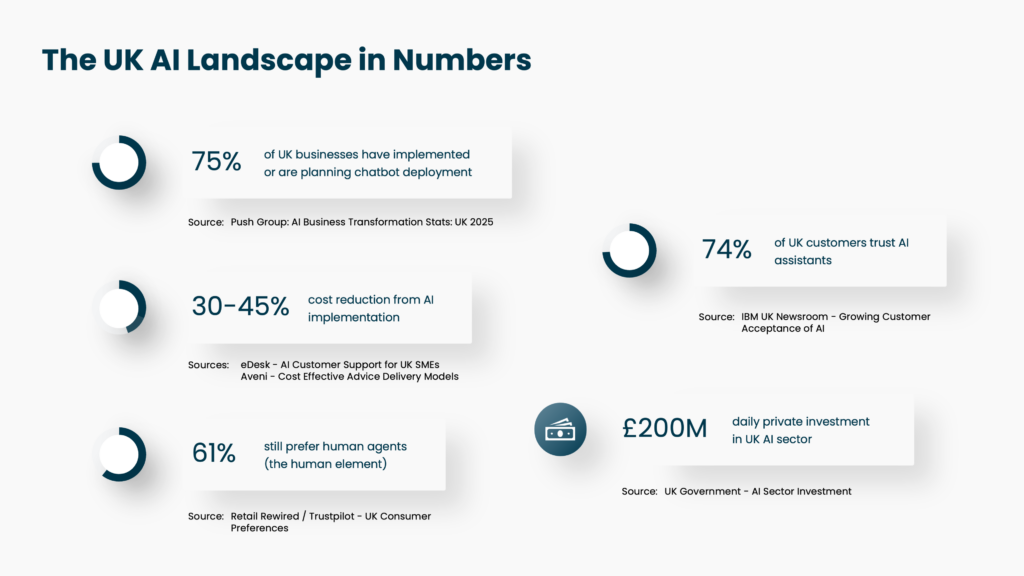
1. 75% of UK Businesses Have Implemented or Are Planning Chatbot Deployment
Three-quarters of UK organisations have either deployed AI chatbots or actively plan implementation, establishing conversational AI as the baseline for modern customer service. Nearly 1.5 million UK consumers have interacted with chatbots within the past year alone, demonstrating established user familiarity and acceptance.
What this means: Chatbots are no longer a differentiator; they’re table stakes. The strategic question has evolved from “Should we implement?” to “How do we optimise beyond our competitors?”
(Source: Push Group)
2. UK AI Customer Service Market Projected to Grow 24.5% Annually Through 2032
The UK AI-for-customer-service sector reached £13.44 billion in 2024 and is projected to expand significantly, maintaining a compound annual growth rate of 24.5% through 2032. This growth significantly outpaces overall UK economic expansion, indicating a fundamental restructuring of service delivery economics.
What this means: The window for first-mover advantage is closing rapidly. Organisations must allocate capital now or face disproportionately higher entry costs and steeper learning curves later.
(Source: LinkedIn Analysis)
3. 85% of CX Leaders Are Now Implementing Customer-Facing GenAI
2026 marks the year generative AI moved from pilot programmes to standard infrastructure in customer service. 85% of customer experience leaders are now actively implementing customer-facing generative AI solutions, using them for 24/7 support, intelligent triage, and real-time agent assistance to reduce operating costs and accelerate resolution times.
These deployments are no longer isolated experiments. They’re embedded in live contact centre workflows across banking, utilities, retail, and telecommunications—the same sectors where UK businesses face the most intense pressure to deliver efficient, high-quality service.
What this means: The “wait and see” window has closed. If your organisation is still in planning or pilot phase, you’re now behind the market standard. The conversation has shifted from “should we implement?” to “how do we optimise what we’ve deployed?”
(Source: Contact Centres)
4. AI Implementation Reduces Customer Service Costs by 30-45%
McKinsey’s analysis provides the financial justification that CFOs require. Companies deploying generative AI in customer service operations achieve cost reductions between 30% and 45%. These savings materialise through multiple mechanisms: deflecting low-value tickets from human agents, reducing average handle times, and enabling 24/7 availability without proportional staffing increases.
What this means: Cost savings of this magnitude fundamentally alter unit economics. The ROI payback period for AI investments typically falls between 18-30 months, with continued compounding benefits thereafter.
(Source: eDesk) | (Source: Aveni)
5. 74% of UK Consumers Trust AI Assistants for Decision-Making Support
Consumer readiness represents the critical enabler for AI scaling. IBM’s comprehensive UK study reveals that nearly three-quarters of British consumers are comfortable with AI-powered assistants influencing their decisions, from tariff plan changes to financial product selections. Trust levels vary by complexity: 62% accept AI for personalised suggestions, while 48% extend trust to enrolment in paid services.
Regional variations show Londoners exhibit 63% trust in AI tools—21 percentage points above the national average—suggesting urban markets lead adoption curves.
What this means: The trust foundation exists for sophisticated AI applications. Organisations must prioritise transparency and explainability to maintain and extend this trust as AI handles increasingly complex customer journeys.
(Source: IBM UK Newsroom)
6. 61% of UK Consumers Confirm Why Human-AI Collaboration Matters
A critical paradox emerges from consumer research: while 54% of shoppers identify speedy response as the most important service element, 61% still prefer human interaction over chatbot engagement. This preference intensifies with age, dropping to 16% among Gen Z but rising to 53% for Baby Boomers.
Only 10% of consumers explicitly desire increased AI usage in customer service, indicating that deployment must be invisible and augmentative rather than substitutive.
What this means: AI strategies must focus on human-AI collaboration, not replacement. The winning formula uses AI for speed while preserving human touchpoints for emotional complexity and relationship building.
(Source: Retail Rewired / Trustpilot)
7. £200 Million in Private Investment Flows into UK AI Sector Daily
The macroeconomic environment signals massive capital commitment to AI infrastructure. Since summer 2024, UK AI companies have attracted an average of £200 million in daily private investment, totalling over £14 billion in fresh capital commitments following the AI Opportunities Action Plan publication. This funding velocity creates a talent and technology ecosystem that accelerates innovation cycles and reduces implementation costs for end-user organisations.
The investment surge includes 13,000 new AI-related jobs, expanding the available expertise pool.
What this means: The growing UK AI ecosystem means implementation barriers; cost, talent availability, and vendor maturity, are dissolving rapidly. Delayed adoption forfeits advantages of this improving infrastructure.
(Source: UK Government)
8. AI Chatbots Achieve Up to 92% Customer Satisfaction Rates When Optimised
Performance data from deployed systems debunks myths about inherent AI service quality deficits. Bank of Montreal’s AI customer service bots handled over two million queries between August and October 2024, achieving customer satisfaction rates reaching 92%. This performance level matches or exceeds human agent benchmarks for routine enquiries.
The key differentiator lies in implementation quality: successful deployments invest in continuous training, sentiment analysis integration, and seamless escalation pathways to human agents.
What this means: Satisfaction rates correlate with implementation sophistication, not technology selection alone. Leaders must budget for ongoing optimisation, not just initial deployment.
(Source: Shout Digital)
9. Around 80% of Routine Customer Service Issues Can Now Be Resolved by AI
Current 2026 guidance for contact centres treats human agents handling basic FAQs like “Where’s my order?” as an efficiency red flag. Research cited in 2026 contact centre analysis shows that approximately 80% of common customer service enquiries can be resolved autonomously by AI, with Gartner projecting similar levels of autonomous resolution becoming standard by 2029.
Conversational AI is already automating millions of support queries globally, cutting response times from hours to seconds whilst escalating only complex or emotionally charged cases to human agents.
What this means: This is the benchmark UK leaders should measure against. If your AI isn’t deflecting most routine queries, you’re operating below the 2026 standard and paying a cost penalty for every simple enquiry that reaches a human agent.
(Source: Gartner)
10. AI Implementation Frees 30% of Agent Time While Reducing Call Handling by 25-35%
Operational impact data demonstrates dual benefits: productivity gains for human agents and direct cost reduction. UK businesses report that AI automation frees approximately 30% of agent time previously consumed by routine tasks. Simultaneously, contact centres implementing AI-driven routing and assistance see call handling times decrease by 25-35%.
This combination allows organisations to either reduce headcount while maintaining service levels or redeploy talent to high-value activities like retention sales and complex problem resolution.
What this means: The business case extends beyond cost cutting to revenue generation. Freed agent capacity can be monetised through proactive outreach, upselling, and enhanced customer lifecycle management.
(Source: Wingenious)
Conclusion
The statistics paint a clear picture for UK customer service leaders: AI has transitioned from competitive advantage to competitive necessity. With 30-45% cost reduction potential, 74% consumer trust, and 92% achievable satisfaction rates, the business case for AI adoption is compelling.
Yet the 61% human preference statistic serves as a critical reminder, successful implementation requires human-AI orchestration, not replacement. The organisations achieving the best results use AI for speed and scale whilst preserving human touchpoints for complexity and emotional engagement.
The window for first-mover advantage is narrowing. With the UK AI market growing 24.5% annually and 80% of customer care organisations deploying generative AI by end of 2025, delayed adoption creates increasingly difficult competitive gaps to close.
The most effective path forward starts with proven use cases that deliver quick wins, then expands systematically to more complex scenarios. Organisations that act decisively position themselves to capture value from an increasingly mature ecosystem.
Sources
- Push Group – AI Business Transformation Statistics UK:
https://www.pushgroup.co.uk/blog/ai-business-transformation-statistics-uk
- LinkedIn – UK AI Customer Service Market 2025 Trends & Forecasts: https://www.linkedin.com/pulse/uk-ai-customer-service-market-2025-trends-forecasts-1exxc
- 2026 CX Leadership Research – GenAI Implementation Rates:
https://contact-centres.com/the-ai-journey-to-intelligent-customer-service-in-2026-and-beyond/
- eDesk – AI Customer Support for UK SMEs:
https://www.edesk.com/blog/ai-customer-support-uk-smes/
- Aveni – Cost Effective Advice Delivery Models:
https://aveni.ai/blog/cost-effective-advice-delivery-models-ai-automation-uk/
- IBM UK Newsroom – Growing Customer Acceptance of AI:
https://uk.newsroom.ibm.com/growing-customer-acceptance-of-ai-in-uk
- Retail Rewired / Trustpilot – UK Consumer Preferences:
https://retailrewired.co.uk/2025/08/18/uk-consumers-push-back-against-customer-service-chatbots-with-61-preferring-human-interactions-trustpilot-data-reveals/
- UK Government – AI Sector Investment:
https://www.gov.uk/government/news/uk-ai-sector-attracts-200-million-a-day-in-private-investment-since-july
- Shout Digital – Perception of AI in Customer Service:
https://www.shoutdigital.com/insights/the-perception-of-ai-in-customer-service/
- Tech Monitor – Customer Service Leaders & Conversational AI:
https://www.techmonitor.ai/digital-economy/ai-and-automation/2025-customer-service-leaders-conversational-ai-2025
- Wingenious – ROI of AI Implementation UK Case Studies:
https://www.wingenious.ai/blog-posts/roi-of-ai-implementation-uk-business-case-studies